The Power Game (ESPN’s ‘Baller-in-Chief’ Piece)
Posted by: Baller-in-Chief in Articles, Featured, Photos(From Wright Thompson for Outside The Lines at ESPN.com)

Washington’s most influential are suddenly taking up hoops, all in the hopes of getting a run with President Obama.
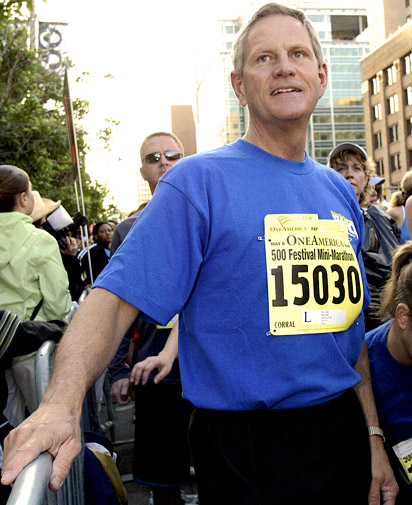
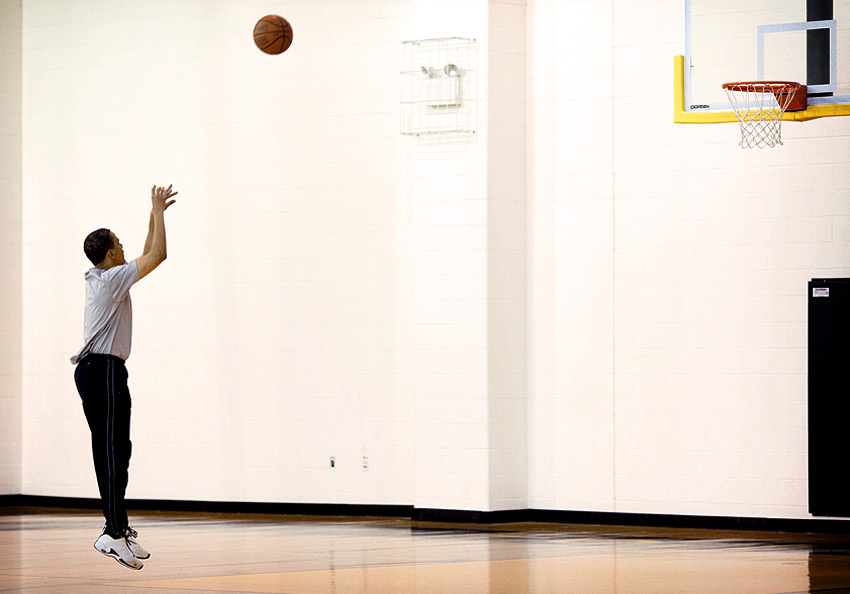
WASHINGTON — Baron Hill is in training, working on his jumper, pumping iron, doing rep after tedious rep on the weight machines to strengthen his bum knee. He swore 15 years ago that he’d never play competitive basketball again, but here he is at his health club, 55 years old, shooting baskets alone. Once, he was an Indiana high school legend, a member of the state’s hall of fame, but those pictures are in black and white.
AP Photo/John Harrell
Just your typical bourgeois midlife crisis, right? Not exactly. Consider who Hill is, where he is and why he’s doing this. For starters, he’s an influential member of the U.S. House of Representatives, a powerful guy, co-chairman of the Blue Dog Democrats. The court he’s on isn’t at a local Y. He’s in Room SB-322 of the Rayburn House Office Building: the famous House gym. There’s a little electronic device he keeps on his key chain that lets him in whenever he wants.
The why is a bit more complicated. Outside D.C., it would seem absurd. In D.C., it’s just doing business. Getting his basketball game up to speed isn’t about him. Well, that’s not entirely true. It’s somewhat about him, about his own political future. But it’s also for the 675,000 citizens of his Indiana district, the people he has been sent here to serve. The reason he’s back in training isn’t because he wants to be but because the president of the United States likes to ball.
“I stayed away from the game,” the five-term Democrat says, “and here I am shooting hoops again. And it’s because of him. If I ever have an opportunity to play with him, I want to be able to halfway get around that court well enough.”
Other congressmen hit the bikes, the weights, the machines. Hill’s alone on the court this morning. At the end of his workout, just like when he was a kid, he won’t leave until he makes 10 straight free throws. He still has that soft touch. When people see him shoot, they stop and stare.
Hooping toward the epicenter
A clarification: There are actually two Washingtons.
One Washington is made up of regular people who do things like eat at a restaurant because they like the food. This is the last you’ll hear of them here.
We’re touring the other Washington, the plastic one, the city of politicians and, because D.C. is more barnacle than boat, those who orbit around them. Citizenship isn’t defined by birthplace or address but by connections. Live next to a powerful senator? Not a chance. Know a powerful senator? You’re in.
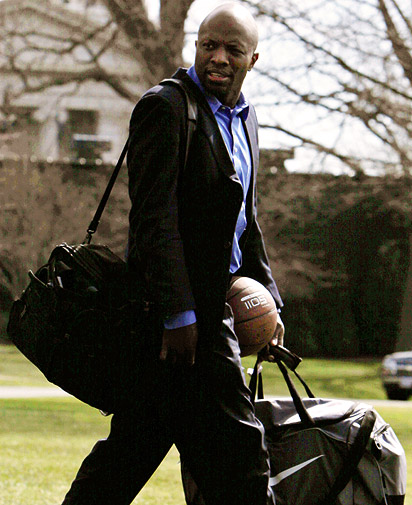
AP Photo/Pablo Martinez Monsivais
This D.C. is a lot like junior high: The student body waits to see what the cool kids do. The president — no matter who — is the coolest kid. People eat where he eats; Obama went to a local burger joint, and now you can’t get a table there. People scheme for the opportunity of a chance encounter. Parents push their own children to befriend his kids. They adopt his mannerisms, his catchphrases, even his sports. Especially his sports. Clinton played golf so everyone in D.C. played golf, working angles to get into a foursome (with Clinton, we might need to clarify that we’re referring to a group of four who enjoy a round of golf together).
One time, a prominent CEO received a coveted golf invite. But he didn’t know how to play, so he tried to learn. The golf lessons became a running joke in the West Wing, a story about pride being the first casualty in the battle for connections. The CEO wasn’t alone. The prime minister of Barbados took lessons, too, and got busted for it by his local newspaper.
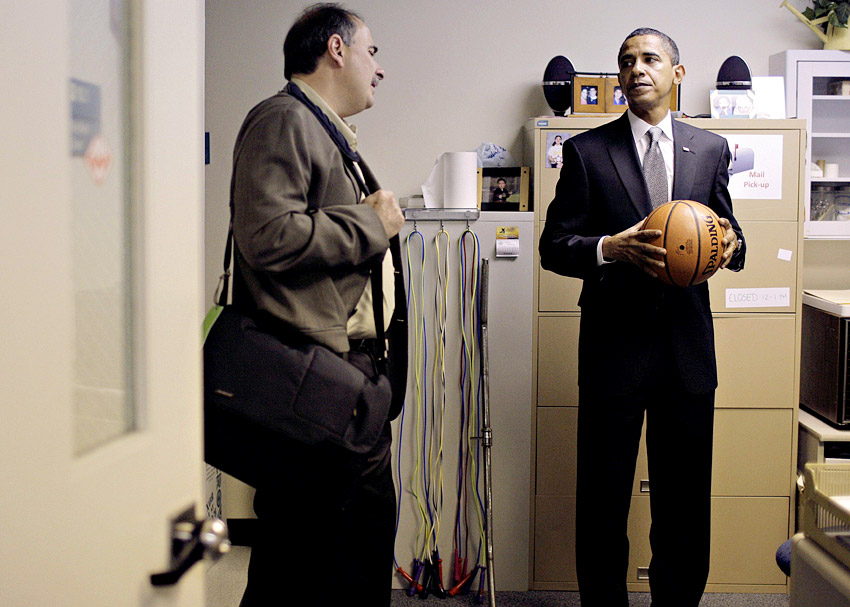
Local powermongers and wannabes like inner circles, even if they’re not in them, because it gives them something to shoot for. There’s a pecking order. Even if you’re never invited to Obama adviser David Axelrod’s house for his casual Wednesday night meeting, you know it exists. It’s a holy grail of access.
Which brings us back to basketball.
Obama loves all things hoops. By executive fiat, the White House tennis court is being retrofitted for basketball. He mentions the game every other speech, including his controversial commencement address at Notre Dame. There’s a blog devoted to his on-court exploits called Baller-in-Chief. His brother-in-law is the coach at Oregon State. His friends hoop. His personal aide, Reggie Love, hooped his way to a national title at Duke and is the gatekeeper for the presidential game. The senior staff hoops. The junior staff hoops. Four members of the Cabinet hoop. Wanna guess what comes next? There’s a new prize to be won.
“What’s the hottest invite in Washington?” former Clinton press secretary Dee Dee Myers asks. “Yeah, it’s great to go to White House state dinners or Stevie Wonder kinds of events. But what’s the sine qua non? It’s a pickup game with Obama. That’s the inner, inner, inner sanctum. Proximity is everything in this town. How close are you to the epicenter?”
No one ever feels close enough, so all over town, people are playing hoops, in newly started leagues, in pickup games at private schools, even in Congress. They’re trying to work their way into games with Obama, or at least with his advisers. Hoops in D.C. has become another way to get ahead.
AP Photo/Punahou Schools (3) and Laura S. L. Kong/Getty Images (middle)
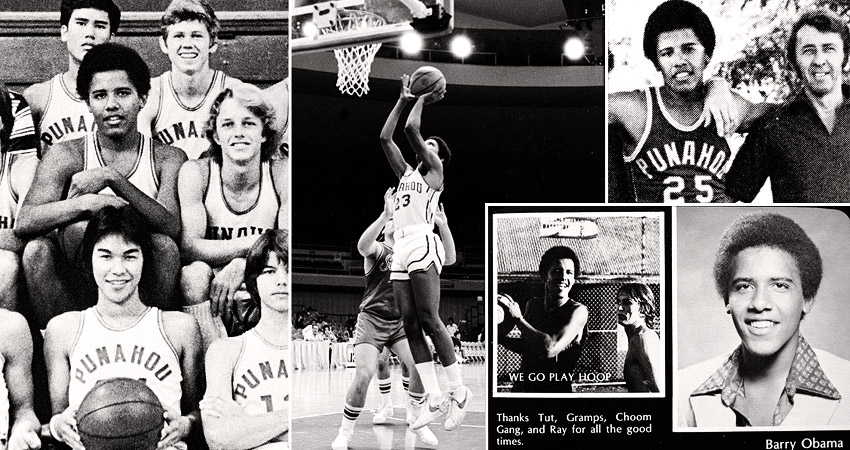
Basketball has been a constant presence in Barack Obama’s life, dating back to his days at Punahou School in Honolulu in the late ’70s.
How things really work in D.C.
For people who don’t spend much time in Washington, all this can be confusing. What’s the difference between hanging out and networking? Isn’t a cigar sometimes just a cigar? Washington doesn’t really make sense until you understand that a moment almost always exists on two levels. There is the moment itself, not unlike a moment anywhere else in the world. Then there is its political shadow, which is far more significant.
Here’s an example.
This is the moment: A breeze blows through the leafy campus of Sidwell Friends School. A sunken quad of sorts sits in the middle of the buildings, steps from the Fox Den Café. When the students are here, this is a beehive of activity. Because it’s Sunday, the place is peaceful. To the left of the chairs and benches is the gym, where a group of middle-aged men get ready to play basketball. Most have been friends for decades; their children and their children’s friends now want in the game. It’s Mother’s Day, so a few regulars are missing, and some guys brought the kids to give Mom a chance to sleep in. One boy spreads out Legos in the corner. It’s a chance for everyone to unwind away from work. “Nobody ever talks about what they do,” Julius Genachowski says.
Who is Julius? Exactly.
Julius plays with his son Jake, who’ll be a senior in high school, and there’s chemistry between father and son. On a fast break with the two Genachowskis out in front, Julius passes the ball to Jake, who lays it in. Jake’s the best athlete out here, and that makes Julius proud. Two summers ago, in their annual one-on-one game, Jake won for the first time. “I’ve been postponing playing with him again,” Julius says, smiling. “I think my time has run out.”
Tom Freedman takes a break to read to one of the kids, a little girl who’s crying. “Let’s stay and watch Dad from here,” he tells her, pointing to her father on the court.
With tag-team baby-sitter rules in effect, Richard Danzig checks out a while later to calm the crying girl. He holds her in his lap and gets out a children’s book. His voice changes, turning silly. “Hey, is this a rabbit?” he reads. “Hey, what about this?”
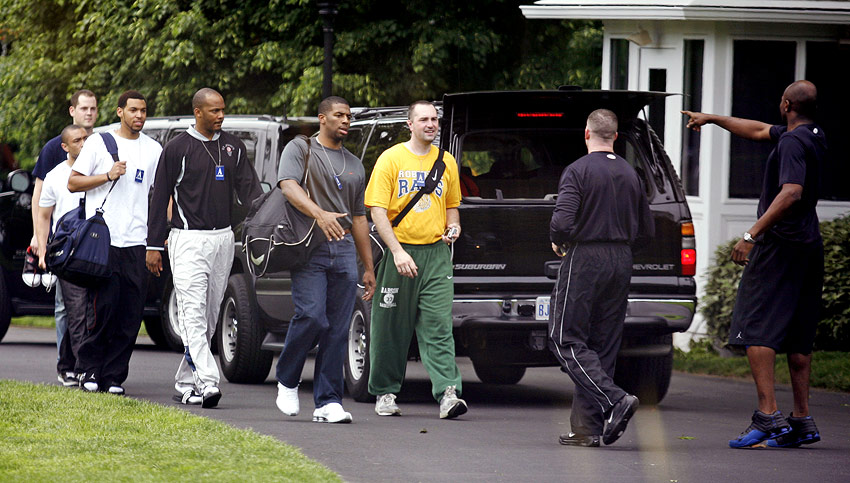
This is the shadow: At the main campus of the exclusive private Sidwell Friends School, where Chelsea Clinton went when her dad was president, and where Malia Obama is a fifth-grader, a group of Washington’s political elite gather. Since the election, so many more people want to play with them that they’ve added a second weekly game. “If you’re interested in Washington types, people who are in and around the administration, the Sunday game is more interesting,” Danzig says. “The Wednesday night game is more young special assistant types.”
Some of the usual suspects are missing, including the chairman of the Federal Trade Commission and the vice president for research at the National Defense University, who was a special adviser to President Clinton from the National Security Council. Obama’s top adviser, Axelrod, who got the office closest to the Oval, has played here.
In addition to running fast breaks, Julius Genachowski is the nominee to head the Federal Communications Commission. He clerked for two Supreme Court justices and went to Harvard Law School with the president, where they were friends and in top positions on the Harvard Law Review together. His son attends the same elite D.C. school that educates White House Chief of Staff Rahm Emanuel’s kids.
Freedman was a senior adviser in the Clinton White House.
Danzig is a former secretary of the Navy, the defense adviser to the Obama campaign who some thought would be secretary of defense. Some think he still will be.
How does getting in a game help?
Teddy Downey sits at a table by the bar at the Hawk ‘n’ Dove, a saloon a few blocks from the Capitol where Hill staffers go for lunch or to tie one on at the end of a long day. He’s 27 and runs a company that provides political analysis to investment firms. It’s his job to know everything that’s going on in town and how it might affect the financial markets. In other words, he sells knowledge, so he plays in two weekly games: with reporters who have inside info and with the staff of the Senate banking committee.
Downey is explaining how basketball is used as a political tool, using as his sermon the well-known Richard Ben Cramer book, “What it Takes,” about the 1988 presidential election. There’s a chapter in the book about knowledge, about how it’s acquired and about its value. Cramer wrote: “Knowledge is power, and the capital is a city built on power, which means knowing and being known. But this is more than a business in Washington. It is life. Only in the bars of Capitol Hill will you hear a normal, healthy young woman responding to the blandishments of her handsome swain with the delighted, breathy question, ‘You know Kerrey?’”
Even if no information changes hands, a game with someone powerful gives the appearance of being inside. Even that kind of interaction is invaluable. It means that in your next business meeting, you can say, “Well, I was just playing ball with so-and-so …” You are one step closer to the center than the other people in the room. They have no idea that nothing important was discussed, so they must assume that it was.
You now have power.
With liberty and playing time for all
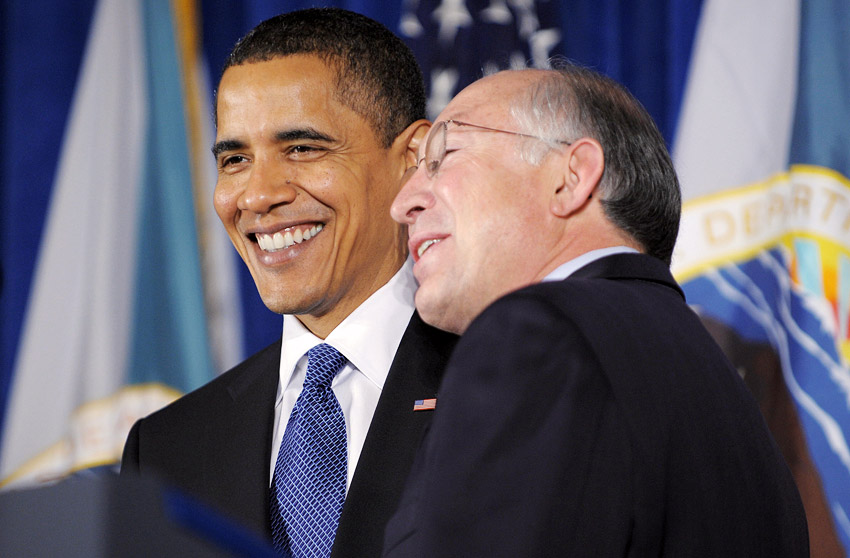
Ken Salazar is secretary of the interior, which means he’s in charge of a whole bunch of cool stuff, like Old Faithful, Lincoln’s birthplace and the indoor basketball court closest to the White House. It’s Tuesday night, and the pickup run is in full swing when he finally gets to the basement of his building. He has been to three or four states today, so there’s a bit of stress to burn off.
“Hey, Mr. Secretary,” calls Ray Rivera, head of external and intergovernmental affairs for Interior and formerly Obama’s campaign chairman for Colorado, “you get the winning squad.”
These games happen twice a week, and because the gym is just four blocks from the White House, folks from there play here, too. In late February, Obama came over one Saturday morning for a game, taking on Salazar and some of his staff. Rivera, who’s outfitted tonight in a Carmelo Anthony jersey, played that day. He had received the call the day before: Be ready. Obama & Co. won. “We’ve been asking for a rematch for months,” Rivera says. “That was like the second week we were here.”
The games are fluid. There’s a good energy on the court. People talk on defense. When Salazar finally gets in, it’s obvious he is actually pretty athletic, and he has a lot of hustle. He’s not easy to cover. Someone yells, “Who’s got Secretary?” Other than being addressed by his title, Salazar is treated like everyone else. Look around at the court right now. Don Gips, the director of personnel at the White House, is in the game, too, setting devastating picks. Then another regular, Sen. Bob Casey, D-Pa., joins in. So now, on the court at the same time, are a Cabinet secretary, the guy in charge of administration hiring, a U.S. senator … and a bunch of staff members, some of them very junior. This is the dramatic difference between basketball and golf. Nobody’s taking an intern to play golf at Congressional Country Club. Basketball is much more democratic. During a break, Casey is talking to scheduler Courtenay Lewis, explaining that she should treat him like anyone else.
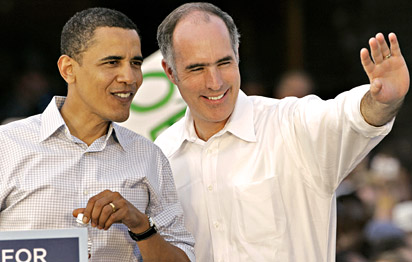
“I fouled you, and you didn’t call it on me,” he says.
“Well …”
“You should have,” he says.
(Don’t think everyone acts like Casey. This, after all, is Washington, and politics trump everything, even democracy. A story: Former Division I player interviews for a job at the White House, an entry-level administration position. At the interview, he is told that there likely could be a position for him in one of the departments — and that he’ll be invited to play in one of their pickup runs. Oh, and a final piece of advice: If you get into a game before the job is finalized, let the other team win. No tomahawk dunks on a potential benefactor. Capisce?)
Special assistant Jonathan Jourdane looks around at the court. He works for Rivera, who works for Salazar. The other guys are calling him “All-Star,” and the secretary points out how much joy he brings to the game. And although Jonathan Jourdane is a name you might be hearing on the evening news in a decade or two, right now he’s about as low on the food chain as you can get. But he’s in Washington playing basketball with some really important people, so he must be doing something right.
A little later, that bright, bright future flashes before his eyes. Jourdane’s and Casey’s feet get tangled. Casey, a former college player who came back to basketball to play with Obama during the campaign, hits the ground hard. There’s a gasp. Oh, my god! Did Jourdane kill the senator?
Casey gets up, dusts himself off. The gasps turn to laughs. Casey’s one of those laughing. This is a moment that will, almost certainly, be brought up again. And again.
“You tripped the senator,” cracks Brian Screnar, Salazar’s White House liaison . “You’re never allowed in Pennsylvania again!”
Basketball Klutzes Inc.
OK, somehow you manage to get yourself invited to a game with a senator or cabinet secretary or, by a miracle, the president. But you actually suck at basketball, and talent is a tough thing to fake on the court. Now what?
Well, you might try calling Arthur Jackson.
For fun, he’s the commish of Secretary of Education Arne Duncan’s Saturday morning run at The Lab School of Washington. His day job is president of One on One Basketball, a company that organizes youth training camps in the area. To get to Jackson’s office, turn on a narrow side street off Mass Ave. and pull into the parking garage. In the shadows, there is a green door that leads to, of all things, the back of a flower shop. That’s where he works. The place smells like a garden.
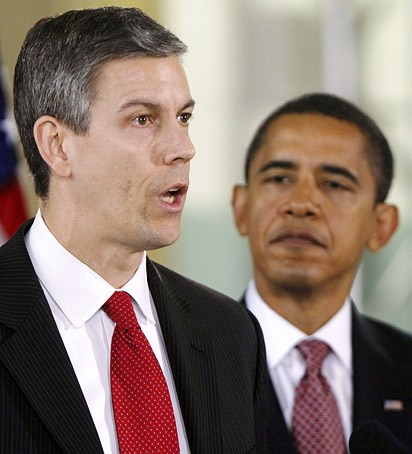
In what little time he has left over in his day, Jackson coaches two youth teams. This winter, Bernard Muir, a teammate of Jackson’s at Brown who is the athletic director at Georgetown, invited Jackson to bring the kids to a Hoyas game. Coincidentally, Washington Mayor Adrian Fenty (who has played ball with Obama and Jackson) invited him to the same game. Jackson asked the mayor whether he could bring the kids up to his box. The mayor said yes. In the suite, Arthur ran into Duncan, which is where the Lab School run was born.
Watching all of this closely was the parent of one of the kids and CEO of a nonprofit company who does work on the Hill. The next time he saw Jackson, he pulled him aside: “I have a business idea.”
He laid it all out: The president and his confidants play hoops, which put people you could never get on the phone in regular games, which made others play hoops, which made the ability to play basketball a legitimate club in the bag of Washington power. Would Jackson be interested in giving basketball lessons on Capitol Hill?
Well … sure. “I think there’s a big market,” Jackson says. “The law firms, the lobbyists are gonna want to be able to get into these games. And they won’t want to embarrass themselves once they get out there.”
The image of a wing-tipped brown-noser learning to execute a crossover is hilarious, but a lot of people around town, when they stop laughing, say it won’t ever happen. Why? If the lessons weren’t totally secret, it would defeat the purpose. The only thing worse than not operating is being caught operating. Jackson gets that. He’s figuring out a way to offer classes firm by firm in a private gym. He hopes to start executive training in the fall.
Everybody’s got the fever
In December, there wasn’t a regular pickup game in the House gym. By February, lots of congressmen had rediscovered their love for the sport. Former NFL quarterback Heath Shuler, D-N.C., is the game’s commish, and they go almost every morning at 6:30. “I’ve been playing for the last month or so again,” says Rep. Rick Larsen, D-Wash. “Everybody wants to get in on the first administration versus Congress basketball game.”
The first commish of the House game was New York Rep. Tom Downey, father of Teddy Downey and one of the Watergate Babies of ‘74. He arrived back then to find a single wooden half-moon backboard attached directly to the wall. That wouldn’t stand. Downey, 25 then and brash, began a lobbying campaign for glass backboards. A run was born. The MBA (Members Basketball Association) guys love to tell the war stories, like the time Bill Bradley, the senator and former New York Knick, needed support for his tax reform bill and came to make connections. “We’ve got the ball at half court,” recalls Mike Oxley, a former congressman from Ohio. “He’s on point. I’m in the corner. I throw it to the top of the key, and Bradley throws the ball to where I should have been. I’m standing there picking my nose. I’ll never forget the look he gave me: Is it worth it to play with these clunkers?”
Downey, who lost his seat in 1992, tells one about his friend Tom McMillen, who became a congressman in 1987, a year after his NBA career ended. “The most terrified McMillen ever looked in all the years I knew him,” Downey says, “was when he heard Magic was coming down.
“‘I’m not gonna cover him,’ McMillen says.
“‘No, no,’ I say, ‘why should you cover him? You played in the f—ing NBA. You’re 6-11. You expect me to cover him? You expect Russo to cover him? He’ll make you look bad? He makes people look bad in the NBA. Of course he’s gonna make you look bad.’”
(Another quirk of D.C.: There are often 10 versions of the same story, all told with equal conviction. Case in point: McMillen says he wasn’t there when Magic Johnson played.)
Eventually, the game deteriorated, and by 2006 it had died. Then Obama was elected to the White House. A game with him became currency, at home with voters and in town with colleagues, like invitations to watch the Super Bowl or a ride on Air Force One. (Emanuel employs a detailed system to keep track of who scores face time.) Hill, whose early endorsement helped Obama carry Indiana, was even asked to play basketball with the president at Camp David, although the White House later canceled the trip. “I’ll get one in,” Hill says. “I’m pretty confident in that. Maybe two if I play well enough.”
Hoops was back. Plans began for a White House-Congress game. Both sides talked smack. The House run caught on, led by young members who loved basketball. They played half court for a while, then switched to full court, going baseline to baseline, then icing down joints in the locker room and limping the next day in the halls of Congress. Word got back to Pennsylvania Avenue. Not long ago, Shuler was at the White House. The first words out of the president’s mouth, Shuler remembers, weren’t about health care or foreign policy. No, Obama led with a question: “How’s the pickup basketball coming over there?”
Shuler said the game was good enough to make sure nobody, not even the president, could take it to the hole.
“Mr. President,” he said, “you can’t bring that stuff inside.”
“Don’t worry,” Obama said. “I pick the teams.”
Desperately seeking Obama
The invites to play with the Baller-in-Chief have been scarce. Mostly friends and staff — the old Chicago crew. “The only thing that’s changed is we’re playing at Camp David,” cracks Duncan, who has known the president for years.
The secretary and some staff at Interior got a run, as did some old buddies of Love’s. Arizona Cardinals QB Kurt Warner got an invitation, as did at least one member of the U.S. House of Representatives. The mayor of Washington got a run. Everyone else is angling. Love apparently keeps a list of names in case he needs extras.
If you don’t have Love’s extension, there’s another, more circuitous road. Play with an Obama confidant — and play really well. The best baller in Obama’s Cabinet, without question, is Duncan, who got a tryout with the Boston Celtics and played professionally in Australia. Duncan plays a lot, but his regular game is on Saturday mornings at the Lab School, which is located between the Georgetown Reservoir and the German Embassy.
“That’s gotta be the screening game,” says Matt Laczkowski, a former North Carolina walk-on who runs hoops at a swanky D.C. health club. “It’s gotta be.”
The guys park their cars and change shoes. Most played college basketball; some played overseas. It’s a curious mix. Two played at Harvard. One, former Maryland guard Jeff Baxter, roomed with Len Bias and was there when he died.
Arthur Jackson uses a winch to lower the backboards from the ceiling. This run is his baby; he sends out an e-mail on Thursdays to a tightly controlled group that includes NFL wide receiver Antwaan Randle El and John Rice, brother of Susan Rice, who is the U.S. ambassador to the United Nations. The first 15 to reply are in.
Fourteen are here so far. Right now, this run is two degrees removed from Obama, several times over. One guy is tight with the mayor, who is tight with Obama. Another guy went to college with Love, who is tight with Obama. A third guy played college ball with Duncan, who is tight with Obama. When Duncan finally gets here, they’ll be just one degree removed. He’s probably just running late.
Sean Tuohey, a D.C. native and former Catholic University player, moved back to town only recently. He had co-founded a basketball nonprofit called PeacePlayers, which used hoops to bring together communities in Northern Ireland, Israel, Palestine and South Africa. When he got back from all those places, he didn’t fit into the corporate structure needed to keep a business running, so he quit. Now he’s searching. He is a strange combination of a dreamer and an operator, and he started playing ball again with a goal: Obama. Tuohey says he has lost something of himself lately and believes he could get some reflected mojo from the president. He believes hope is contagious. “The tidal wave that is Obama was so strong,” he says, “you’ve got to get in it somehow. I’m going out playing again, for very selfish reasons. Obama made the game very trendy again because it’s a way to advance yourself.”
The first time Tuohey got in this game, he felt the pressure. Diving for loose balls, willing the balls in the hole, hoping that maybe, just maybe, Duncan would stop him after the game and say, “I really like how hard and smart you play. Why don’t we stay in contact?” Afterward, he introduced himself to a guy he thought was Duncan … and found out he wasn’t even there. The next time, he actually got a few minutes to tell the secretary about the inner-city schools he works in.
The run is intense, and the guys not playing enjoy the breather. Tuohey, Baxter and Duke alum Jason Goldblatt sit against the wall and talk about the rumor Obama plays secret games at Walter Reed Army Medical Center. Does he drive? Take Marine One?
“Walter Reed has a pad,” Baxter says.
“I’m sure he plays early, so it doesn’t matter if it’s 16 cars,” Goldblatt says.
“If he’s playing, I bet Arne Duncan is playing,” Tuohey says.
“I wonder if Reggie is playing?” Goldblatt says.
“Did you know him at Duke?” Tuohey asks.
“Yes,” Goldblatt says. “I might send him an e-mail telling him about this game. Trajan Langdon’s on the e-mail distribution list.”
Soon, it’s their turn again. The games go until everyone is exhausted. Duncan never shows up. They can all read why in The Washington Post the next day.
He was playing with Obama.
Hooping at the epicenter
The Obama guys are waiting for someone to come open the gym at Sidwell Friends. They met on the campaign trail, and they’re just getting settled into Washington. Some work at the White House now; others have ended up at various agencies. Everything’s still new.
They’re throwing a football around, quickly turning idle activity into an alpha competition: first one to get the ball through the tire swing on the jungle gym. Technically, it’s a jungle gym, but it looks more like something designed for the Apollo missions. The thing cost more than some of their cars. The school costs more per year than their annual take-home pay. It’s where their boss’ daughters go.
“Every kid’s parent is a doctor,” says Herbie Ziskend, a staff assistant in the vice president’s office.
White House press assistant Ben Finkenbinder laughs.
“Or president,” he says.
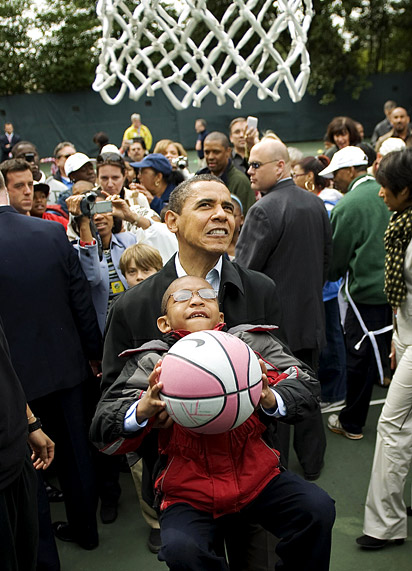
Work still brings a sense of wonder. Before the game starts, the guys catch the latest gossip, brought by someone who was just in the office. They’d seen actor Dulé Hill and Reggie Love walking the halls together. Dude, Charlie and Reggie! The guy who played the president’s aide on “The West Wing” and the president’s actual aide, together. They love that. They love doing important work with important people in an important place. Finkenbinder is one of the youngest people to have a West Wing desk. Well, it’s more of a ledge, with the office printer beneath it, and he shares it with another staffer, a woman named Katie Hogan. But only four doors, two hallways and the Roosevelt Room separate them from the president of the United States.
“Probably about 25 feet,” Hogan says.
How many steps?
“In heels, 12. In flats, 10,” she says, laughing.
Anyone a dozen steps from the Oval Office is, by definition, important. That’s a new experience. Finkenbinder was taken aback by the idea. It didn’t occur to him that other people in Washington might play basketball because he and his friends and their boss like to play basketball. That’s the other truth about D.C. trends: The closer you get to the epicenter, the more people do things because that’s just what they do.
When Finkenbinder got to D.C., he began asking around for a run. He still hadn’t found one when Love called in late February. The president had a game at the Department of the Interior. Would he like to play?
That’s how he found out about the gym at Interior and how the White House junior staff ended up playing its Tuesday night game there. The commish of the Interior game is White House intergovernmental affairs staff assistant John Oxtoby. He’s in the Sidwell run, too. People around town are starting to figure out that he’s the guy who sends out the e-vites. One person, who makes his living by knowing and being known, as Cramer put it, brought up the game and Oxtoby’s name. He says: “They really want to keep it all staff. This guy annoys the s— out of me because I have to e-mail him.”
The rules of the Tuesday game are strict. The first 12 to reply are in. At Sidwell, one guy comes over to Oxtoby to plead his case to play in the Interior game. “When do you send out the Tuesday evening e-mail?”
“Sometime Monday,” Oxtoby says.
“I’m gonna be on an airplane Monday,” the guy says, asking whether he could reserve a spot early.
“You can’t do that,” Oxtoby says.
When it gets going, the Sunday Sidwell game is pretty good. Finkenbinder’s the best player on the floor today. A few guys sit out each run. Rock, paper, scissors to see who goes in if anyone needs a rest. When they’re done, they collect their BlackBerrys and head toward the door. They’ve all got work in the morning.
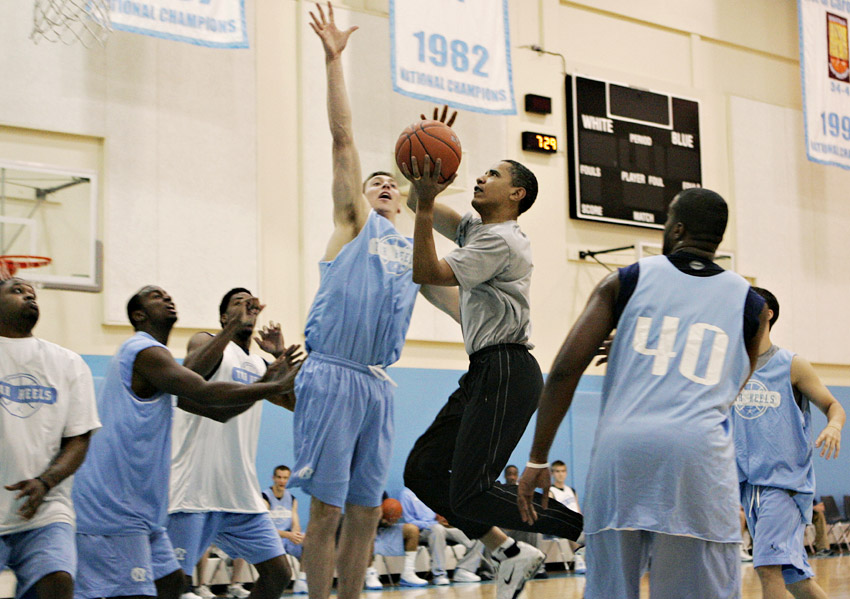
For one power broker, it’s a tension-releasing hobby
Everyone’s waiting at the South Lawn for the president: members of Congress, the North Carolina basketball team, Tar Heels coach Roy Williams and his wife, a line of television cameras, and some White House staffers. Finkenbinder is making sure the media stay behind the rope. Wrangling, it’s called. His job is literally to herd the media like they’re alpacas. His phone rings: more staffers who want to see the national champion Tar Heels honored.
There’s an announcement — “Ladies and gentlemen, the president of the United States” — and Obama steps to the podium. He’s funny, cracking jokes about the time he played with the Heels during the campaign, about Reggie Love’s going to Duke. He nods at the UNC grads on his staff, who are standing off to the side.
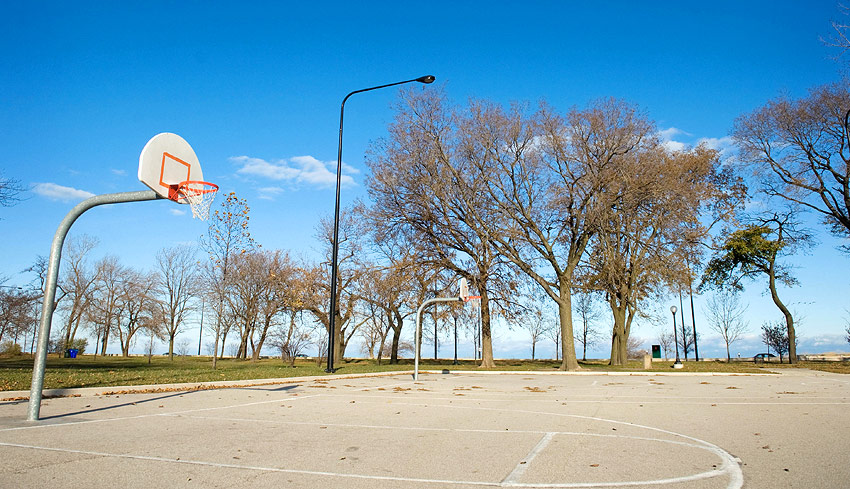
These visits seem fun for him. He even took the UConn women’s team down to his outdoor basket for a game of P-I-G (he won). Throughout his life, he has found peace on the basketball court. It has been a companion, from his lonely childhood all the way through the campaign. It’s how his future brother-in-law checked him out when he started dating Michelle. He has played to relax and to make political friends, for fun and for work. He has followed it as a fan, keeping an eye on a game while reading briefing papers and Foreign Affairs magazine. Now he can play with anyone he wants. Now the best teams in the country come to his house and present him with jerseys.
“If somebody could just present me a jump shot,” he says afterward. “I need one of those.”
He heads back to his office, past the West Colonnade, where the famous picture of the Kennedy brothers was taken, past the withered pink roses, past the Secret Service agent on post at the door that leads to the West Wing, toward the two plants by his entrance to the Oval Office. During his walk, if he looks to his left from the Rose Garden, he can see the top of his backboard, just down the hill from his desk, peeking above some trees and his daughters’ jungle gym. Outside the gates, it’s a holy grail. Inside, it’s where the boss goes to unwind.


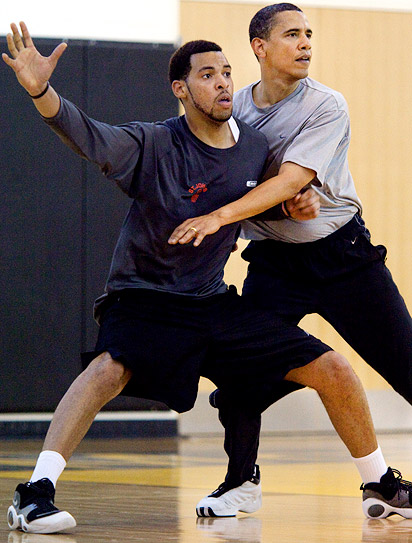
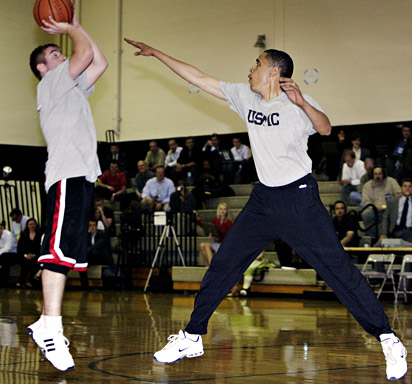
 Obama looked worry-free in December 2007 before playing one-on-one against SI senior writer S.L. Price in Des Moines, Iowa.
 Loading ...