Bowling, Basketball, BCS, Baseball, and Birdies: Obama’s Use of Sport to Connect
Posted by: Baller-in-Chief in Articles, Baseball, Basketball, Photos(From Russ Crawford for LA Progressive.com)
 |
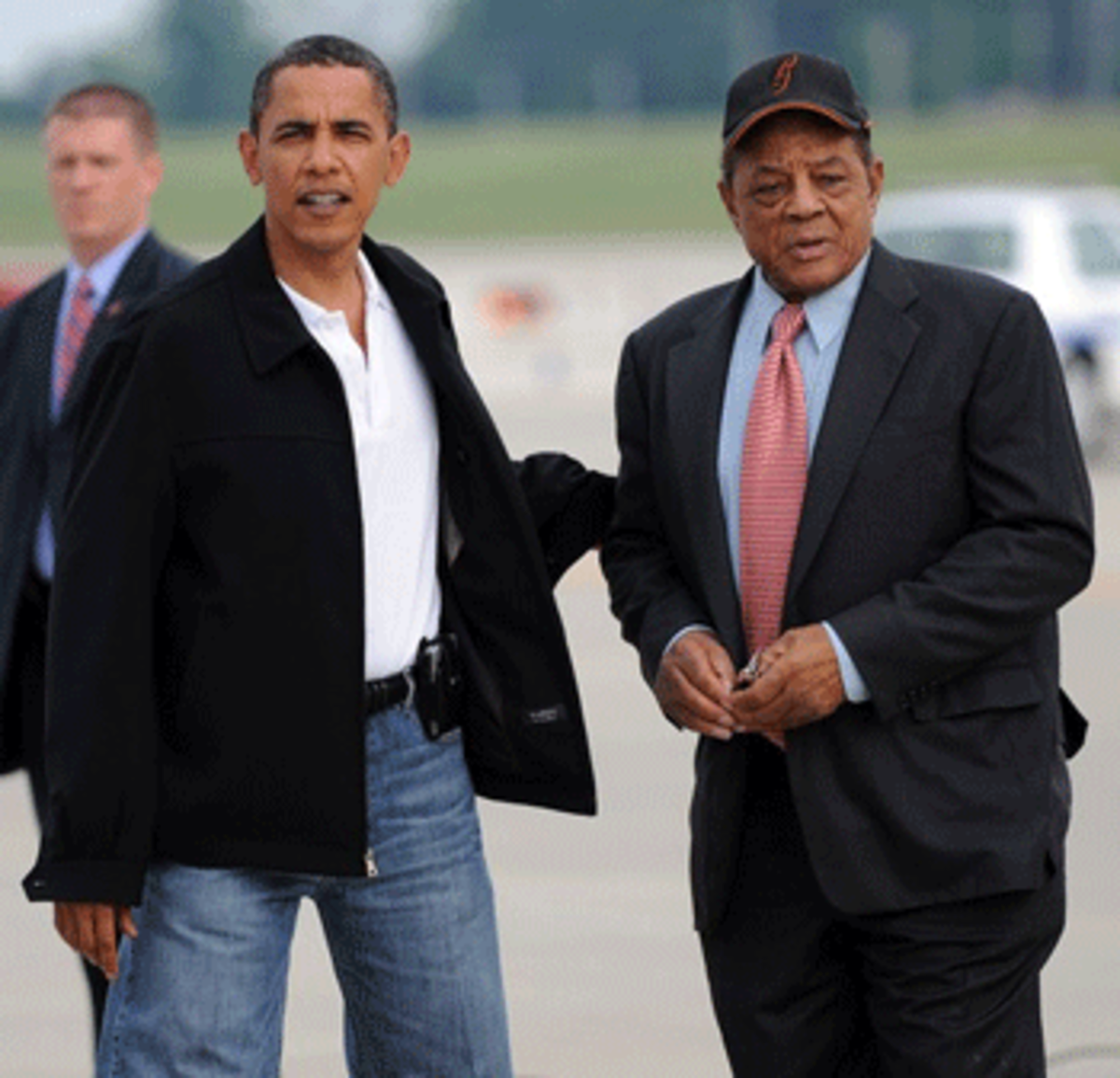
President Barack Obama threw out the first pitch at Major League Baseball’s All Star Game after flying to the game accompanied by Hall of Famer Willie Mays, and visiting the players in the clubhouse before the game. He also appeared, along with former presidents, in a video celebrating community service broadcast before the game and joined the broadcast booth during the second inning of the game. A busy and sport-filled day for the new president who has used sport extensively, both as a candidate, and in his first year in office.
Sport has taken an increasingly visible role in presidential politics in recent years. During his 2000 election race, when a reporter asked George W. Bush what mistakes he had made in his life, a theme that reporters would return to often, he answered that he traded Sammy Sosa to the Chicago Cubs. One of his first interviews after his inauguration was with Bob Costas on Costas Now, and during his first year in office he began the practice of opening the White House grounds to Tee Ball on the South Lawn.
John Kerry, Bush’s opponent in the 2004 election ratcheted up the visibility of sport by taking part in hunting trips, snow boarding, and a variety of other sports, including windsurfing – which backfired when Republicans used the images to re-enforce his flip-flop image. These outings were reportedly intended to “humanize” the candidate who suffered from a less than warm image with the public.
Politicians using sport for their own ends is at least as old as Theodore Roosevelt threatening to ban football from college campuses unless something was done to lessen the brutality of the game, but President Barack Obama has increased the frequency of the use of sport to further his political aims, going beyond his predecessors in significant ways. His participation in and conscious use of sport are at once an attempt to connect with the bulk of the sporting public and an acknowledgement of the importance contemporary American culture attaches to games.
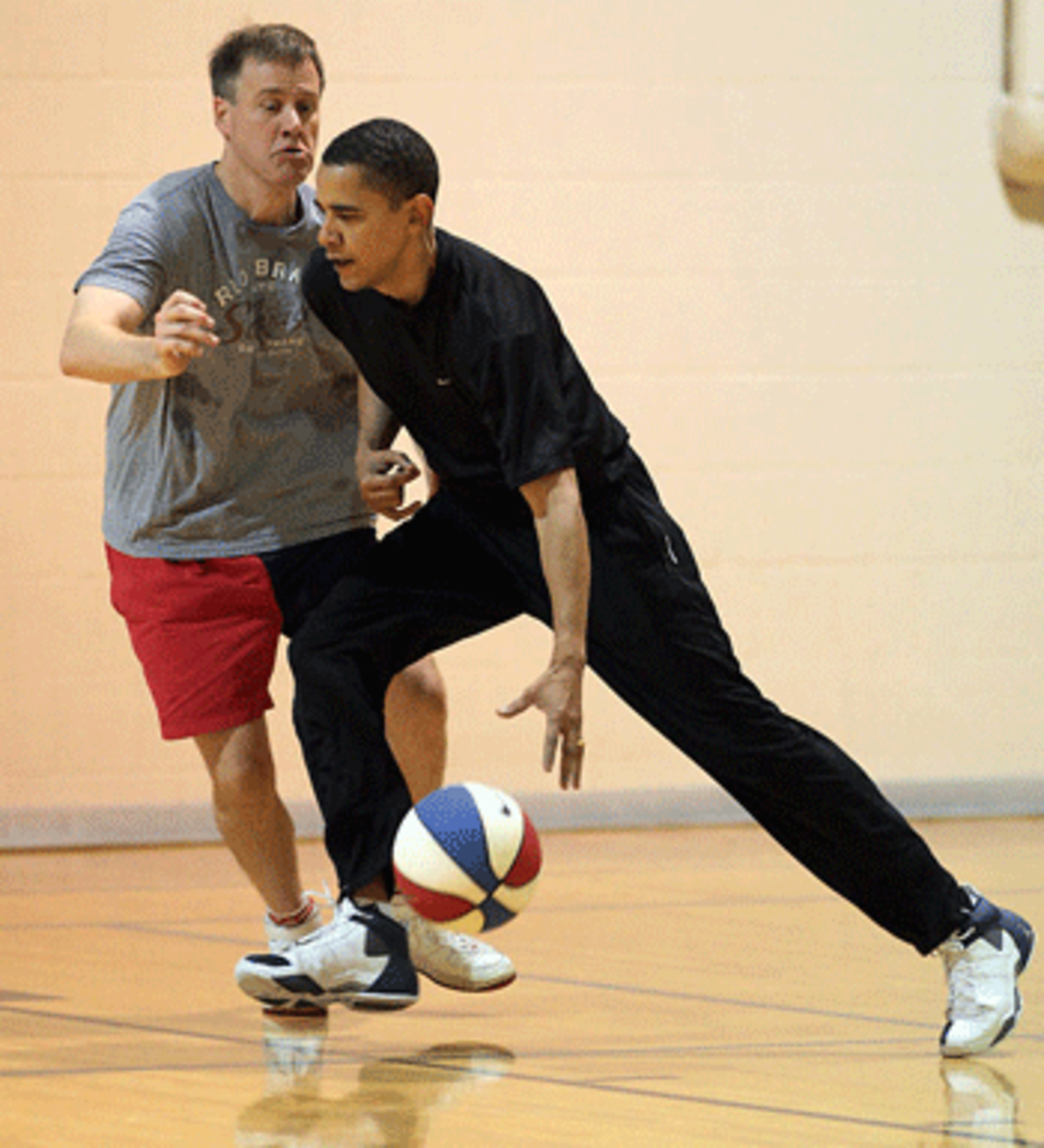
During his run for the presidency, Obama, a high school basketball player, was often pictured playing hoops, and after turning in a miserable performance at bowling, joked that, if elected, he would replace the presidential bowling alley with a basketball court. He also maintained a rigorous workout schedule, finding time, according to an article by Washington Post writer Eli Zaslow, for at least 90 minutes a day during the end of his hectic campaign and into the transition period.
This was not a significant change from George W. Bush, his predecessor, who was steadfast in his cycling, or Bill Clinton who enjoyed a morning jog, although sometimes to McDonalds, and most presidents since Teddy Roosevelt have engaged in some form of physical activity during their presidency. As an advocate of the vigorous life, Roosevelt was perhaps the most famous of the presidential athletes, participating in boxing, hiking, hunting, and other active pursuits while in the Oval Office, but the new president seems bent on outdoing his early Twentieth Century predecessor.
Roosevelt also began the presidential habit of using the “Bully Pulpit” to encourage other Americans that participation in the strenuous life was in their best interests. Other presidents have also taken time from their busy schedules to address problems in the sporting world, including Harry Truman who, according to the daily schedules maintained by his presidential library, met on several occasions to discuss the college basketball point shaving scandal in the early 1950s, and George W. Bush who addressed the steroid scandals in baseball.
Obama has likewise used his bully pulpit so far to urge the National Collegiate Athletic Association to scrap the controversial Bowl Championship Series format for Division I football and adopt a playoff system to crown its champion. Candidate Obama urged this change in an appearance on Monday Night Football just before the election, and repeated his wish for a playoff during a 60 Minutes interview later that month and has continued calling for change since taking office. Obama’s immediate predecessor, who did not shy away from taking controversial positions, apparently felt that the BCS was too hot to handle, reportedly being overheard saying that he had no opinion, other than to being sorry that the Texas Longhorns weren’t in the championship game.
Presidents have also used sport to connect with voters, placing themselves at the center of the attention that such events attract. Every president since Howard Taft has thrown out the first pitch at Major League Baseball games, and this activity placed, and was intended to place, them at the center of the American way of life that celebrates team sport, and the nominal National Pastime. In recent years, the venues for these celebrations of the American way have been expanded to include NASCAR (W. Bush) and Monday Night Football (Obama), among others.
 |
For the sheer frequency of sports appearances, pronouncements, and use however, Obama has set a pace that is beyond anything his predecessors did in office. He has used sport for everything from getting elected to touting his first nomination to the United States Supreme Court, and expanded the scope of presidential visibility in the sporting world.
Even before he officially became a candidate, Obama recorded a message for MNF that began sounding political speaking about whether a contender from the Midwest had any chance, but ended with him donning a Chicago Bears cap and vocalizing the “da da da da” opening theme of the telecast. Both he and his opponent John McCain were interviewed by Chris Berman during the last game before the election, making them the first candidates interviewed on that program.
When the president announced his nomination of Sonya Sotomayor to replace Justice David Souter on the Supreme Court, he prominently mentioned that “Some say that Judge Sotomayor saved baseball,” referencing her 1995 injunction that prevented Major League Baseball owners using replacement players and effectively ending the 1994 Strike. He also mentioned that his nominee was a lifetime Yankee fan, adding that he hoped that would not “disqualify her in the eyes of New Englanders in the Senate.”
By way of contrast, when John F. Kennedy nominated Byron “Whizzer” White to the Supreme Court in 1962, his message omitted any mention of the nominees’ impressive athletic resume. The best athlete to ever sit on the Supreme Court, a 1937 college All American halfback at Colorado, a member of the College Football Hall of Fame, and one of the highest paid professional football players during his brief (1938-1941) career, Kennedy’s nominating statement, according to the New York Times, read only that “ ‘ I have known Mr. White for over 20 years.’ The President said. ‘His character, experience and intellectual force qualify him superbly for service on the nation’s highest tribunal.’ ”
The new president has also been hitting the links of late, continuing a tradition that began with Taft, but with some differences in interpretation. Golf has often been a source of controversy for presidents. For instance, Dwight Eisenhower was often ridiculed as the “duffer in chief” for his frequent golf outings. According to Associated Press reporter Joseph White, JFK, arguably the best presidential golfer, kept his love for the game away from photographers because he was concerned the game was viewed as being too elitist until after he was elected. Gerald Ford was ridiculed for the spectators he struck with his errant drives, which reinforced his klutzy image in the popular culture. George H.W. Bush drew criticism for playing during the Gulf War of 1991, and reinforced charges that he was out of touch with Americans. Bill Clinton was notorious for his constant use of Mulligans, which fed into his reputation as “Slick Willy,” and George W. Bush also was criticized for giving up his trips to the course during the Iraq War.
So far, Obama’s golfing has been depicted favorably by the press, with reports focusing on the relaxation that the game affords the president, what it positively demonstrates of his character, and its ability to connect him to normal people. According to Don Van Natta Jr. in an article for Golf Digest, golf companions stretching back to his days as a state senator in Illinois verify that Obama counted all of his strokes and maintained his equilibrium in the face of a less than polished game, testifying to his integrity and cool under pressure. Obama himself stated that he was drawn to the game as a way of connecting with his colleagues in the state senate and his constituents in down-state Illinois. In an analysis of photos of the president golfing, Michael Bamberger of Golf.com, commenting on the president’s attire, observed that “nothing says regular-[J]oe golfer like cargo shorts.”
During “interesting” times, a president dealing with two wars, and economic crises finding time for 9 holes in the midst of a hectic schedule might come in for criticism for such trivial pursuits, but to this point, we have only heard platitudes for the latest presidential duffer.
Obama’s use of sport continues the tried and true practices of his predecessors of employing the powerful medium of games to connect to the large percentage of the American public in a way that political speeches cannot. Throwing out first pitches, and other uses of sport, allows a president to engage in a spectacle that focuses positive national attention on them, and offering little in the way of a downside. While there were scattered boos and his pitch fell just short of the plate, Obama’s performance at the All Star Game was a positive one for him. Images of the president with heroes from the past such as Mays, joking with current players before the game, and his banter with the announcers during the game earned him mostly positive press, something that every politician works hard to achieve.
Taking on the BCS likewise offers little risk. Officials in charge of the system were not impressed by the president’s call for a playoff, but the bulk of college football fans have little love for the complicated and often seemingly unfair system. This represents a way for Obama to connect to voters in a positive way that his economic or social policies might not.
Linking himself to sport programs such as Monday Night Football, and using baseball to pre-sell his judicial nominee also offers the president a chance to prove to the American electorate that he, and she, are one of them. During the campaign, the right continually accused Obama of being a radical or a socialist, and radio commentators like Rush Limbaugh and Sean Hannity continually brought up the candidate’s connections with controversial figures such as former radical Bill Ayers, and Reverend Jeremiah Wright. Placing himself in a sporting context allowed Obama to provide visual and rhetorical evidence that he was in the mainstream of American culture. The same is true of Sotomayor. By hailing her as the savior of baseball, the National Pastime, the president attempted to shape her public image as being solidly within the American way. The implicit message is that no one who enjoys football or baseball can be a radical – they are as American as apple pie and baseball.
The centrality of sport in the American way has a history stretching back to baseball’s use as a unifying national pastime in a country desperately searching for something to hold it together in the face of the increasing likelihood of civil war. In the late Nineteenth Century, muscular Christians saw sport as the path to salvation, both morally and physically, for a middle class increasingly engaged in sedentary pursuits that could lead to the downfall of American and perhaps Western Civilization. In the 1920s, sports heroes such as Babe Ruth and Lou Gehrig were often better known and more beloved than whoever happened to be in the White House. During the Second World War when soldiers were not engaged in combat, they were often engaged in friendlier fields of strife on the diamond or the gridiron. Especially during the early decades of the Cold War, sport was consciously used by policy makers to strengthen the American way by inculcating the purported values of sport – teamwork, integrity, physical vigor – in American youth, making them less susceptible to the blandishments of communism and physically able to withstand any attack. Since the late 1960s and 1970s, the role of sport and the values it may build have come into question, but in presidential politics, it remains a potent method of reaching out to voters.
Whether Obama’s use of sport continues to be an effective tool remains to be seen, and already signs that the opposition will challenge that use have began to emerge. The headline on the right leaning Fox News website read “Obama’s Ceremonial Pitch at All Star Game Barely Reaches Catcher’s Mound,” and on his Wednesday program Limbaugh contended that the president “throws like a girl.” It will also be instructive to see if anyone picks up Obama’s lack of a glove on the mound, given the controversy that ensued during the campaign over his refusal to wear an American flag lapel pin.
According to Frank Carnavale, Obama was to wear a special glove made for him with the number 44 and an American flag, but during the game the glove was nowhere to be seen. It is unlikely that President Obama’s use of sport will slow down, but the frequencies of attacks on such use are only likely to increase.



 Loading ...