(From Kevin Ding for the Orange County Register Online)
WASHINGTON — Sometimes maintaining calm with his light touch, other times gathering storms by unleashing emotion, Lamar Odom was and still is the Laker to look to for feeling.
Odom, the heart of the 2008-09 championship team’s pregame huddles, was the middle man who connected with all the teammates around him, so it was most amazing to see him muted Monday.
Odom was downright awkward he was so nervous about the Lakers’ visit to the White House to celebrate their title with President Barack Obama. The thing is, you’re only that nervous when what’s coming up means that much to you.
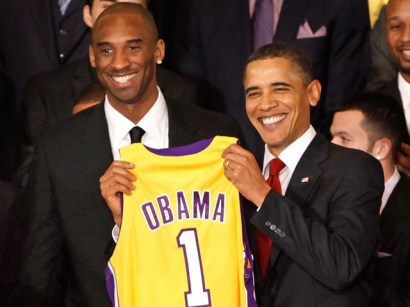
Monday meant that much to the Lakers, who come away from the day with a refreshed outlook on their existence as champions. That’s because Obama offered a unique reminder on greatness just in the short time he spent with them.
However you feel about Obama’s political stances, there’s greatness in the man who has risen the way he has. The Lakers were, to quote Coach Phil Jackson, “in awe” of the president. But in the same way a relaxed, friendly demeanor from a completely confident Kobe Bryant can disarm terribly anxious kids nervous about meeting him, Obama connected with the Lakers with ease.
The ever-expressive Odom was stone-faced as the president quoted Odom in his speech about the Lakers’ championship run. Odom was in obvious disbelief that the president was actually quoting him.
“I wish I had a tape recorder,” Odom said later, back to his usual big laughter with the formal ceremony over.
But standing in the back row of the risers, Odom was stiff and shifty-eyed. Bryant later explained: “Lamar’s very emotional. He actually went and saw President Obama speak at the (Democratic) convention in Denver.”
It was therefore unbelievably great for Odom and all his teammates that Obama cracked on him in that private time on stage when he was shaking their hands goodbye.
“How’s married life?” Obama asked Lamar.
“Beautiful,” Odom answered quietly.
“Yeah, you’d better say that,” Obama said then for all Odom’s teammates to overhear, “because she’s sitting right there!”
That was the unpublicized dialogue with the president’s back to the audience that produced such laughter on stage. It was so entertaining that Shannon Brown had to cover his mouth and Derek Fisher couldn’t help but start clapping.
“It was hilarious,” Bryant said.
Obama’s knowledge of the Lakers — not just in reality TV marriage material, but in the basketball game he so loves — left them feeling special. That’s not a simple trick to pull off in a half-hour or so.
Obama could not have known that Odom gets ribbed with the nickname “Mr. Kardashian” on the practice court, but the president somehow pushed the right button. He did the same thing with Magic Johnson, kidding him about losing to Obama’s local team, the Chicago Bulls, in the 1991 NBA Finals.
When Obama tried to be like Mike and pantomimed Jordan’s famous right-then-left layup against the Lakers while looking back at Johnson, it was just the kind of communication these guys are used to — the good-hearted ripping that guys give other guys they like — and Johnson certainly got the message without a trace of mean-spiritedness.
“It was really a special moment in time that I’m always going to remember: President Obama trash-talked Magic Johnson,” a grinning Johnson said later. “Me restraining myself not to come back at him. Because he was the only man on Earth that I ever let trash-talk me and not say anything back. Because I’m competitive, too, right? But it was a great moment.”
There were other sweet moments, particularly for Bryant as he watched his wife and daughters in the front row of the audience approached by Obama.
“It means everything to me,” Bryant said. “As a father, you’re just a proud parent to see them being able to interact with the president of the United States.”
Bryant supports and admires Obama — to the point he collected newspaper front pages the day after the election — and has taught his daughters about him. That’s why Bryant noted he got to spend time with President George W. Bush in 2002 on a similar visit but dismissed Bush as a baseball guy.
This was the visit that Bryant deemed “perfect.”
(Just like all you Bryant fans who wonder why his teammates continue to high-five him on that fractured right index finger, Obama recoiled at first when shaking hands with Bryant backstage before the ceremony for fear of aggravating the injury. The president knew what was up.)
The ceremony wasn’t “perfect” for everyone. It was too bad all Lakers staffers didn’t get a chance to meet the president as was originally promised. That audience was also overly stuffed with political people who asked to be there instead of set up with all Lakers folks closest to the front. New Laker Ron Artest, another big Obama backer, missed out after developing flu-like symptoms in the morning.
Yet the overriding sentiment still shined through the same way the warm sun did on this January day in Washington. Besides Obama having a State of the Union address to prepare for, no one seriously considered scheduling time for the Lakers with Obama on his new outdoor basketball court because it was unimaginable the weather could cooperate the way it did.
The Lakers will have to get back to basketball without that smooth lefty known as Barry O’Bomber as a high school hoopster. But they won’t forget his confidence and excellence when they return to the court.
It’s a demeanor they admired from afar coming in and now can learn from coming out.
They came in as that little fifth-grade girl who dared approach Bryant after the team’s Monday morning coaching clinic for local children and was rewarded with his practice jersey.
But the truth is that Obama admires the team, too. And it should encourage the Lakers to make him proud again.
“I still get enormous, enormous pleasure from watching great athletes on the court,” the president said. “And nobody exemplifies excellence in basketball better than the Los Angeles Lakers last year.”



 Loading ...